
How Technology has changed our life
 From sexy smart phones to lightning-fast PCs to GPS, it's hard to imagine life without technology. But have all the new gadgets and tools only made our lives more complicated?
Through the years, we've watched technology grow like a child budding into adulthood: It starts out mostly crying and pooping, then crawling, gradually learning to walk, and finally able to run at a speed we all wish we could keep up with. We've seen technology fail, and we've seen it succeed. We've poked fun at it when it doesn't make sense, and we've praised it when it's absolutely brilliant. We've yelled at it when it runs out of power, and we've fixed or replaced it when it gets run down.
We treat technology as a family member—even if that is a little co-dependent. You can't blame us, though; it's certainly made aspects of our lives easier: We're no longer forced to send letters through the postal service, book vacations through travel agents, shop in stores, visit the library for research material, or wait for our photos to be developed. Thanks to technology, all of these activities can be performed either digitally or online.
At the same time, though, technology can make life more convoluted—especially when something doesn't work right or doesn't do what it's supposed to: Say, for instance, a GPS device tells you to turn the wrong way on a one-way street (yikes!), or a computer erases all of your important data (ouch!).
Unfortunately, it's not always easy to understand how a product or service works, not to mention whether or not to hold off on adopting it until a better, shinier thing comes along. A perfect example is the ever-evolving video format. We've gone from Betamax to VHS to DVD to HD DVD/Blu-ray to just Blu-ray (and everything in-between, of course). It can take years before a technology catches on, and even more time before we see a significant price drop.
For the most part, however, technology does us more good than harm: It's reconnected us with old college roommates, helped us learn a foreign language, and encouraged us to exercise. Follow us as we look back at how technology has changed our lives—for the better and for the worse—in terms of communication, computing and entertainment.
Computing
Before word processors there were typewriters. Keys were punched and a typebar would hit an inked ribbon in order to make an imprint onto paper. For each new line of text, we had to push a "carriage return" lever. If a mistake was made, we'd grab for the sticky tape that could remove the black ink of a typed character, or paint over it with Wite-Out. There was no way to save our work or make copies.
Then before computers there were word processors, which allowed for the editing of text. Later on, new models were introduced with spell-checking programs, increased formatting options, and dot-matrix printing.
The Good:
Today, the personal computer has become an integral part of our lives. What was once a bulky machine taking up all of the space on our desk (remember the IBM PC and Apple II?), the personal computer is now a sleeker system that's capable of storing terabytes of data and operating at lightning-fast speeds.
PCs are no longer deskbound, either. Laptops and netbooks (also known as ultramobile PCs) are now capable of performing similar tasks and functions as their desktop counterparts while being optimized for mobile use. They are easy to carry (weighing anywhere from 2 to 12 pounds), and they're convenient for working while on the go. Netbooks in particular are beginning to take off: ABI Research forecasts that shipments of netbooks as well as Mobile Internet Devices are expected to exceed 200 million in 2013.
Through the use of computers, we've mastered the art of multitasking: typing articles by using word-processing programs such as MS Word and Open Office, checking e-mail through Microsoft Outlook, designing and optimizing images and photos with Adobe Photoshop, building a digital library of our favorite music with Apple iTunes, and much, much more.
The Bad:
Undoubtedly computers save us a lot of time, but we might depend on them a little too trustingly. It's possible to lose tons of data if a drive crashes and we haven't backed it up. We've counted on Spell Check to make our words literate, but it's certainly not a good copy editor. Computers tend to distract students in class, as well; they'll surf the Web when they should be taking notes. Even relationships have suffered from excessive use of the computer, from World of Warcraft sessions to work projects to—yes—online porn.
Entertainment
Before there were electronics, people found simple ways to entertain themselves: Curling up with a good book, knitting by the fire, listening to the radio, and playing Bridge. There was no such thing as cable television, boom boxes, or Spore.
The Good:
Technology has provided us with even more creative ways to occupy our time. Thanks to Sony, Nintendo, and Microsoft, we can play video games, competing with friends and other gamers from around the world to master fighting, strategy, and sports titles. While some parents may argue that video games are violent and addictive, healthy amounts of game time can actually be beneficial to a child's development. A study by Information Solutions Group for PopCap Games discovered that playing video games can improve concentration, increase attention span, and provide positive affirmation, especially in children suffering from ADHD. In addition, we can burn calories while playing Wii Fit.
As far as music goes, we used to have to pop in another cassette tape or CD once one reached the end. Today's portable music players (PMPs)—such as the Apple iPod touch and Microsoft Zune —have redefined how we listen to and access music. We're able to store gigabytes of music on a PMP and listen to thousands of songs on one player. And when we get tired of the music on them, we simply load different tunes.
Traditional paperbacks and hardcovers are now inching towards e-books. With Amazon's Kindle, we have access to more than 150,000 e-books at any given time. We can adjust the font size of the text we're reading (there are six different options). In addition, the Kindle offers 180MB of onboard memory, which means we can carry up to 200 books at once.
Watching TV involves more than just our television and cable box these days. Digital Video Recorders (DVRs) like the TiVo HD XL enable us to pause, rewind, and fast-forward live TV as well as record TV shows when we're not at home. If we're bored with watching our tired DVD collection, there's always renting movies and buying TV shows from our couch using Apple TV. This nifty digital media extender also lets us play digital content onto our TVs from any home Mac or Windows machines running iTunes.
The Bad:
While we can't imagine being without these engaging devices, technology can at the same time hold us back from truly enjoying life. There's still nothing like flipping through the crisp pages of a traditional paperback. Listening to music with earbuds divert us from hearing the incredible sounds of nature. Video games are great for eye- and hand coordination, but it doesn't hurt to turn off the console and go hiking or out to dinner with friends as an alternative. And instead of recording almost every show on TV, stick to the ones you're actually going to watch.
click here to read more.....

At home with Robots:The coming Revoluton

Normally, we think of robots as humanoid and self-aware, like Rosie or Data. Some day, they might be more like that, but robots are here in our homes today, cleaning our floors and even making our coffee. What does the future of human-robot relations hold?
You might not think you have robots in your house, but think again. There's your dishwasher, for instance; you put dishes in it, walk away, and a half hour later they're clean. Same thing with your washing machine. Or your programmable coffeemaker.
Though these everyday mechanical devices aren't humanoid, they are on the robotic spectrum, in the sense that they perform functions with minimal human involvement.
"People use the word 'robotics' a lot, and it means a lot of different things," Rich Hooper, a robotics consultant who develops and designs computer-controlled machines for Austin, Texas-based Symtx, told TechNewsWorld. "Robotics has gotten so loosely defined that it means almost anything with movable parts."
Steve Rainwater, a robot technologist and editor of the Robots.net blog, agrees.
"'Robot' is a word that's almost impossible to define; it has come to be used for too many different things these days," Rainwater told TechNewsWorld. "Personally, I think of robots as autonomous machines that evolved initially with the help of humans. I also tend to think of the word robot as an ideal that we haven't really achieved yet, rather than just a description of the artifacts that have resulted from trying to realize that ideal."
Growth of an Industry
Whether they're called robots or just smart machines, these devices are quickly becoming an everyday feature of our lives. In fact, according to a study done by the International Federation of Robotics, there were 3.4 million personal domestic service robots in use at the end of 2007, and it predicted another 4.6 million domestic service robots will be sold between 2008 and 2012.
"The first possibility is that we'll eventually have general purpose humanoid robots that do many tasks and interact with us more or less like we interact with each other," Rainwater said. "This is the future so often predicted in science fiction stories. You might want to ask your household robot to do the dishes, babysit the kids, mow the lawn, or play a game of chess with you."
The smart machine path is one other -- perhaps more likely -- future.
"The other possibility is that homes of the future will have function-specific robotics integrated transparently into the house itself," Rainwater said. "The house will become a network of smart machines that interact with you and each other." 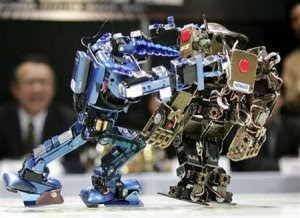
The Future Is Now
iRobot is one company that helped to make robots part of our everyday lives. There's the Roomba, which is an automatic vacuum cleaner, and the Scooba, an automatic floor washing system. Then there's the pool-cleaning Verro and the gutter-cleaning Looj.
"Roomba made practical robots a reality for the first time and showed the world that robots are here to stay," the company's Web site says. "With nearly two decades of leadership in the robot industry, iRobot remains committed to providing platforms for invention and discovery, developing key partnerships to foster technological exploration and building robots that improve the standards of living and safety worldwide."
Founded in 1990 by roboticists Colin Angle and Helen Greiner and headquartered in Bedford, Mass., iRobot has more than 400 employees and a wide selection of household robots.
Other robots available to consumers now are items like the Clocky, an alarm clock that spins away if it's chased, produced by Nanda; or security robots that travel around the premises of a home or business sold by companies like MobileRobots.
Honda has also been working on a humanoid robot project called "Asimo." Still in the development phase, Asimo can carry trays, push carts, climb stairs, and do a number of other tasks. In the future, it might be used to care for the elderly, provide service at social functions, and do simple housework. It is also being developed to work in conjunction with other appliances.
"In the home, Asimo could someday be useful as it can connect wirelessly to the Internet to retrieve requested data, for example," Alicia Jones, Honda's North American Asimo Project Supervisor, told TechNewsWorld. "Asimo could also be integrated with other household electronics so that it could control those devices as requested by a user. Of course, it will still be some time before Asimo is ready to help in other ways in the home."
Robot Rights
Robots continue to fascinate people, if only because they see themselves reflected in these machines. And as they become more common, questions of the ethics of this kind of labor might come to the fore.
"If you're doing something that a human can do, you might as well have a human do it," Hooper said. "As much as I like robots, I don't really identify with them."
Rainwater argues the other side of this debate, suggesting that robots might eventually have something akin to basic human rights.
"Robots are fascinating because, unlike all the other machines we humans have invented, they're the first that may someday have the capacity to be our friends and companions," Rainwater said. "In a sense they're our children. Some people think robots may even eventually become our evolutionary successors. That's something to think about before you kick that robot dog that's annoying you."
click here to read more.....
RSS FEED


