
How New Artificial Intelligence Can Help Us Understand How We See

scientists have, for the first time, used computer artificial intelligence to create previously unseen types of pictures to explore the abilities of the human visual system.
Writing in the journal Vision Research, Professor Peter McOwan, and Milan Verma from Queen Mary's School of Electronic Engineering and Computer Science report the first published use of an artificial intelligence computer program to create pictures and stimuli to use in visual search experiments.
They found that when it comes to searching for a target in pictures, we don't have two special mechanisms in the brain - one for easy searches and one for hard - as has been previously suggested; but rather a single brain mechanism that just finds it harder to complete the task as it becomes more difficult.
The team developed a 'genetic algorithm', based on a simple model of evolution, that can breed a range of images and visual stimuli which were then used to test people's brain performance. By using artificial intelligence to design the test patterns, the team removed any likelihood of predetermining the results which could have occurred if researchers had designed the test pictures themselves.
The AI generated a picture where a grid of small computer-created characters contains a small 'pop out' region of a different character. Professor Peter McOwan, who led the project, explains: "A 'pop out' is when you can almost instantly recognise the 'different' part of a picture, for example, a block of Xs against a background of Os. If it's a block of letter Ls against a background of Ts that's far harder for people to find. It was thought that we had two different brain mechanisms to cope with these sorts of cases, but our new approach shows we can get the AI to create new sorts of patterns where we can predictably set the level of difficulty of the 'spot the difference' task."
Milan Verma added: "Our AI system creates a unique range of different shapes that run from easy to spot differences, to hard to spot differences, through all points in between. When we then get people to actually perform the search task, we find that the time they take to perform the task varies in the way we would expect."
This new AI based experimental technique could also be applied to other experiments in the future, providing vision scientists with new ways to generate custom images for their experiments.
click here to read more.....

New Robot With Artificial Skin To Improve Human Communication
 Work is beginning on a robot with artificial skin which is being developed as part of a project involving researchers at the University of Hertfordshire so that it can be used in their work investigating how robots can help children with autism to learn about social interaction.
According to the researchers, this is the first time that this approach has been used in work with children with autism.
The researchers will work on Kaspar (http://kaspar.feis.herts.ac.uk/), a child-sized humanoid robot developed by the Adaptive Systems research group at the University. The robot is currently being used by Dr. Ben Robins and his colleagues to encourage social interaction skills in children with autism. They will cover Kaspar with robotic skin and Dr Daniel Polani will develop new sensor technologies which can provide tactile feedback from areas of the robot’s body. The goal is to make the robot able to respond to different styles of how the children play with Kaspar in order to help the children to develop ‘socially appropriate’ playful interaction (e.g. not too aggressive) when interacting with the robot and other people.
“Children with autism have problems with touch, often with either touching or being touched,” said Professor Kerstin Dautenhahn. “The idea is to put skin on the robot as touch is a very important part of social development and communication and the tactile sensors will allow the robot to detect different types of touch and it can then encourage or discourage different approaches.”
Roboskin is being co-ordinated by Professor Giorgio Cannata of Università di Genova (Italy). Other partners in the consortium are: Università di Genova, Ecole Polytechnique Federale Lausanne, Italian Institute of Technology, University of Wales at Newport and Università di Cagliari.
click here to read more.....
At home with Robots:The coming Revoluton

Normally, we think of robots as humanoid and self-aware, like Rosie or Data. Some day, they might be more like that, but robots are here in our homes today, cleaning our floors and even making our coffee. What does the future of human-robot relations hold?
You might not think you have robots in your house, but think again. There's your dishwasher, for instance; you put dishes in it, walk away, and a half hour later they're clean. Same thing with your washing machine. Or your programmable coffeemaker.
Though these everyday mechanical devices aren't humanoid, they are on the robotic spectrum, in the sense that they perform functions with minimal human involvement.
"People use the word 'robotics' a lot, and it means a lot of different things," Rich Hooper, a robotics consultant who develops and designs computer-controlled machines for Austin, Texas-based Symtx, told TechNewsWorld. "Robotics has gotten so loosely defined that it means almost anything with movable parts."
Steve Rainwater, a robot technologist and editor of the Robots.net blog, agrees.
"'Robot' is a word that's almost impossible to define; it has come to be used for too many different things these days," Rainwater told TechNewsWorld. "Personally, I think of robots as autonomous machines that evolved initially with the help of humans. I also tend to think of the word robot as an ideal that we haven't really achieved yet, rather than just a description of the artifacts that have resulted from trying to realize that ideal."
Growth of an Industry
Whether they're called robots or just smart machines, these devices are quickly becoming an everyday feature of our lives. In fact, according to a study done by the International Federation of Robotics, there were 3.4 million personal domestic service robots in use at the end of 2007, and it predicted another 4.6 million domestic service robots will be sold between 2008 and 2012.
"The first possibility is that we'll eventually have general purpose humanoid robots that do many tasks and interact with us more or less like we interact with each other," Rainwater said. "This is the future so often predicted in science fiction stories. You might want to ask your household robot to do the dishes, babysit the kids, mow the lawn, or play a game of chess with you."
The smart machine path is one other -- perhaps more likely -- future.
"The other possibility is that homes of the future will have function-specific robotics integrated transparently into the house itself," Rainwater said. "The house will become a network of smart machines that interact with you and each other." 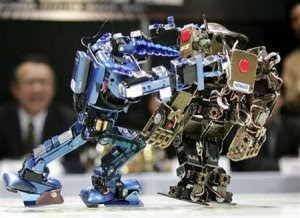
The Future Is Now
iRobot is one company that helped to make robots part of our everyday lives. There's the Roomba, which is an automatic vacuum cleaner, and the Scooba, an automatic floor washing system. Then there's the pool-cleaning Verro and the gutter-cleaning Looj.
"Roomba made practical robots a reality for the first time and showed the world that robots are here to stay," the company's Web site says. "With nearly two decades of leadership in the robot industry, iRobot remains committed to providing platforms for invention and discovery, developing key partnerships to foster technological exploration and building robots that improve the standards of living and safety worldwide."
Founded in 1990 by roboticists Colin Angle and Helen Greiner and headquartered in Bedford, Mass., iRobot has more than 400 employees and a wide selection of household robots.
Other robots available to consumers now are items like the Clocky, an alarm clock that spins away if it's chased, produced by Nanda; or security robots that travel around the premises of a home or business sold by companies like MobileRobots.
Honda has also been working on a humanoid robot project called "Asimo." Still in the development phase, Asimo can carry trays, push carts, climb stairs, and do a number of other tasks. In the future, it might be used to care for the elderly, provide service at social functions, and do simple housework. It is also being developed to work in conjunction with other appliances.
"In the home, Asimo could someday be useful as it can connect wirelessly to the Internet to retrieve requested data, for example," Alicia Jones, Honda's North American Asimo Project Supervisor, told TechNewsWorld. "Asimo could also be integrated with other household electronics so that it could control those devices as requested by a user. Of course, it will still be some time before Asimo is ready to help in other ways in the home."
Robot Rights
Robots continue to fascinate people, if only because they see themselves reflected in these machines. And as they become more common, questions of the ethics of this kind of labor might come to the fore.
"If you're doing something that a human can do, you might as well have a human do it," Hooper said. "As much as I like robots, I don't really identify with them."
Rainwater argues the other side of this debate, suggesting that robots might eventually have something akin to basic human rights.
"Robots are fascinating because, unlike all the other machines we humans have invented, they're the first that may someday have the capacity to be our friends and companions," Rainwater said. "In a sense they're our children. Some people think robots may even eventually become our evolutionary successors. That's something to think about before you kick that robot dog that's annoying you."
click here to read more.....
Blue-eyes Technology:future technology
BlueEyes Technology is the new technology which is going to be on our hand on near future. It is the system developed, intended to be the complex solution for monitoring and recording the operator’s conscious brain involvement as well as his physiological condition.
There are certain questions which need to be answered.
— Is it possible to create a computer which can interact with us as we interact with each other?
— You are sitting in front of your personal computer that can listen, talk, or even scream aloud, share your happy moments and understand your grief.
— It can even understand your emotions at the touch of the mouse, at the sight of your gloomy eyes.
— It seems to be a fiction, but it will be the life lead by BLUEEYES in the very near future.
There are many technologies that are evolving in our world. The main fault in these technologies is observed in the performance. Human error is still one of the most frequent causes of catastrophes and ecological disasters. Due to automated system human beings have become passive observer of the supervised system, which results in weariness and vigilance drop. It therefore is crucial to assure that the operator’s conscious brain is involved in an active system supervising over the whole work time period.
Auto-fire enabled Mouse It is possible to measure indirectly the level of the operator’s conscious brain involvement using eye motility analysis. Although there are capable sensors available on the market, a complex solution enabling transformation, analysis and reasoning based on measured signals still does not exist. Utilization of wireless technology becomes essential. BlueEyes is the system developed intended:
- To be the complex solution for monitoring and recording the operator’s conscious brain involvement.
- And his physiological condition.
This requires designing a Personal Area Network linking all the operators and the supervising system. As the operator is using his sight and hearing senses, the supervising system will look after his physiological condition. The basic idea behind this technology is to give the computer the human power. We all have some perceptual abilities to understand motional state by analyzing his facial expression. If we add these perceptual abilities of human to computers it would enable computers to work together with human beings as intimate partners. The blue eyes technology aims at creating computational machines that have perceptual and sensory ability like those of human beings.
click here to read more.....
RSS FEED


